
Arcimoto (Nasdaq: FUV)

Arcimoto, Inc.’s (NASDAQ: FUV) (“FUV”, “Arcimoto”, or the “Company”) makes electric three-wheeled street vehicles dubbed Fun Utility Vehicles (a.k.a FUV). Arcimoto’s story mimicked many other “tech 2.0” or “Tesla-lite” companies designed to benefit from increased consumer awareness and general city-wide roll-outs of docking station infrastructure for all types of electric vehicles.

In our opinion, Arcimoto lied to investors about its reported “pre-orders” from paying customers and disregarded safety concerns about its vehicles on public roads in order to execute a dubious stock promotion for self-enrichment at the expense of minority shareholders.

In March 2021 we reviewed six (6) different partnerships touted by Arcimoto since 2018. Specifically for these partnerships, we found that less than 5% of Arcimoto’s “pre-orders” were actually delivered.

As part of its fake demand promotion, Arcimoto’s largest customer, Arcimoto Key West, is secretly owned and operated by undisclosed related party insider FOD Capital, LLC (“FOD Capital”). As of July 2020, FOD Capital was FUV’s third largest shareholder. In 2H’20, FOD Capital sold 67% of its FUV shareholdings in traditional pump & dump style…

We identified another undisclosed shareholder who founded Hula Holdings, Inc. (“Hula”), a partnership that was announced in 2018 yet appears abandoned as of today. On November 10, 2020, Hula uploaded a new video of a different warehouse full of vehicles from Arcimoto’s direct competitor, Ayro Inc. (Nasdaq: AYRO, “Ayro”).

Perhaps Arcimoto’s most brazen stock promotion campaign example occurred on November 19, 2020 when it announced a 90-day trial period with the City of Orlando Mayor Buddy Dyer’s office as a potential first responder vehicle. The news fueled FUV stock price to skyrocket from US$ 9 to over US$ 20 within two days.

We were surprised to find that on November 18, 2020, the day before FUV’s Orlando 90-day first responder trial period was announced, Arcimoto filed a safety recall notice with the National Highway Traffic Safety Administration (“NHTSA”) in regards to possible immediate power loss on 100% of its delivered vehicles.

By law, FUV is required to notify customers of vehicles under recall so that the vehicles can be repaired, defective parts replaced, etc.

We spoke with Arcimoto Key West and GoCar Tours whose sales representatives both confirmed neither customer had been notified of Arcimoto’s November 2020 safety recall as of March 2021.

Arcimoto did not tell its investors that 100% of its vehicles were under recall the day before the City of Orlando first responder 90-day trial period announcement.

Elon Musk voiced his own concerns about Arcimoto’s FUV, crashing one himself into a wall and citing it as unsafe.

Electrive reported that Elon Musk crashed an Arcimoto 3-wheel vehicle into a wall in the fall of 2019, and that in September 2020, when a twitter user asked Musk for help with some projects with a video from Arcimoto consultant Sandy Munro, Musk responded succinctly:

“Can’t support three-wheeled vehicles. Not safe enough.” – Elon Musk

Since December 2018, Arcimoto has filed 19 separate recall notices, the majority related to the most basic elements of a vehicle such as power, steering and braking.

While its fun to make toys and sell them to your friends and family, it appears to us that Arcimoto’s commercial production is a pipe-dream since it had failed to produce a safe, reliable and properly working street-legal vehicle.

We are short Arcimoto ($FUV) and think that its stock is going lower.
AgEagle Aerial Systems (NASDAQ: UAVS)

We believe that AgEagle Aerial Systems Inc.’s (“UAVS”, “AgEagle”, or the “Company”) was a pump & dump scheme orchestrated by Alpha Capital Anstalt (“Alpha Capital”), AgEagle founder and former chairman Bret Chilcott and other UAVS insiders to defraud US investors.

In April 2020 rumor of a partnership between Amazon.com, Inc. (“Amazon”, Nasdaq: AMZN) & AgEagle was started by a promotional video uploaded to AgEagle’s founder and former chairman Bret Chilcott’s daughter’s personal website and youtube account (the “Promo Video”). Since then, a 54 page due diligence document has circulated on Reddit which at various times referenced the Promo Video and suggested that the AgEagle’s partnership with Amazon was real.

We have found no evidence of any “major e-commerce customer” or any drone technology credited to AgEagle other than reference to the Promo Video leaked by AgEagle’s founder and former Chairman Bret Chilcott’s daughter.

In 4Q’20 an Amazon spokesperson disclosed to reporter Daniel McCoy of the Witchita Business Journal that Amazon specifically does not have any dealings with AgEagle whatsoever.

UAVS stock skyrocketed on fake Amazon partnership rumors from US$ 0.39 to US$ 16. THE PUMP!

While insider ownership declined from 44% to 0.5%. THE DUMP!

We are short UAVS and think that its stock is going lower.
February 18, 2021 - Short AgEagle Aerial Systems (UAVS) - February 18, 2021

China Harmony Auto (HKEX: 3836)

China Harmony Auto Holding Limited (HKEX: 3836) (“Harmony” or the “Company”) operates ~75 car dealerships in China, distributing mid- to high-end luxury car brands including BMW, Lexus, Land Rover, Rolls Royce, & Ferrari. Harmony is also an after-sales service partner of Tesla (Nasdaq: TSLA) in China which drives additional investor interest.

Evidence revealed that Harmony’s Chairman Feng defrauded investors and fabricated Harmony’s financial statements.

First, Chairman Feng stole RMB 1 billion from Harmony. At the end of 2019, Harmony offset a RMB 1 billion cash loan to Chairman Feng using an abusive tax liabilities transfer. This transaction had serious negative repercussions for Harmony minority shareholders as it effectively erased the contractual obligation for Chairman Feng to repay RMB 1 billion to Harmony.

Second, Harmony generated fake cash from fake share sales. Harmony claimed to receive RMB 192 million in cash from selling shares of Henan Hexie Automobile Aftersales Services Co., Ltd. (河南和諧汽車維修服務有限公司, “IAC”) in April 2019. This never happened, and this was not the first time Harmony lied about cash receipts. In addition, Chinese filings revealed that Harmony never received RMB 347 million in cash from the sale of Green Field Motor Co., Ltd. (浙江绿野汽车有限公司, “GFMC”). To us these findings suggest that Harmony’s cash balance has been fabricated since 2015.

Third, Harmony lied about its profits in two ways: by failing to consolidate operating expenses from primary subsidiaries, and failing to write down losses from bad investments. In this report we highlight three separate entities which Harmony used to generate fake profits.

On January 7, 2020, Ernst & Young resigned as Harmony’s auditor. For its 2019 Annual Report, Harmony paid a different auditor, Zhonghui Anda CPA Limited, who resigned shortly thereafter in July 2020. We suspect both resignations were related to the write-off of the RMB 1 billion loan to Chairman Feng.

CCASS data shows that 94% of Harmony’s shares are in circulation despite Chairman Feng’s reported 44% ownership, suggesting undisclosed share pledges.

We are short Harmony and believe its stock is worthless.

Hyliion (NYSE: HYLN)

Hyliion Holdings Corp. (NYSE: HYLN) is a US$ 4+ billion market cap company that claims its current hybrid technology can be retrofitted to any Class 8 diesel truck for an immediate 30% fuel efficiency savings.

Evidence revealed that Hyliion’s proprietary battery management system technology was purchased for under US$ 1 million, equal to less than US$ 0.01 per Hyliion share!

There is not one scientific paper or submission that would back up Founder & CEO Thomas Healy’s 30% fuel efficiency claim.

Only 3 of the 7 “customers” listed in Hyliion’s June 2020 PPT presentation appear to have purchased a Hybrid-X system. P.A.M. Transportation abandoned its 2 year test of Hyliion’s Hybrid-X system: “The goal is for a 30% improvement in fuel economy, and so far, the savings has only been a small percentage.

On October 15, Jim Cramer’s Mad Money cautioned investors to be patient and that Hyliion is not a buy at these levels. If the bobblehead pundit doesn’t think your stock is a buy, who does?

We are short Hyliion and believe its stock is going lower.

Huazhu (Nasdaq: HTHT)-(HKEX: 1179)

On September 22, 2020 we published our report (the “Report”) which presented evidence why we believe Huazhu Group Limited (Nasdaq: HTHT)(HKEX: 1179) (“Huazhu” or the “Company”) is a real company that lied about the ownership of its hotel portfolio to produce fake financials.

On September 28, 2020 Huazhu filed a clarification announcement (“Huazhu’s Response”) which categorically denied all of our allegations without providing any substantive evidence to refute the facts presented in our Report.

In this Rebuttal we highlight additional evidence showing Huazhu lied about current Huazhu Directors secretly owning and operating Huazhu portfolio hotels. We found Dianping included a link to nearly 100% of the operating license for each Huazhu portfolio hotel. Bonitas Fieldwork confirmed that the displayed on-site operating license matched the Dianping hotel linked image for 100% of our fourteen-hotel sample size.

We counted 1,258 hotels with operating licenses registered to Huazhu subsidiaries and an additional 694 hotels owned and operated by undisclosed current Huazhu employees and other undisclosed related parties (“off-book hotels”).

Huazhu’s Response dismissed the Dianping dataset as outdated and inaccurate.

Huazhu failed to explain away obvious shareholder records that current Huazhu Directors own and operate supposed independent Huazhu franchisee hotels and are listed as approved construction contractors.

Huazhu’s Response dismissed current employees as unrelated parties.

We do not understand how Huazhu denies such obvious connections with current Huazhu Directors.

Chinese State Administration of Industry and Commerce (“SAIC”) records revealed Huazhu understated its SEC reported employee count by at least 16%.

Huazhu’s Response dismissed the SAIC dataset as outdated and inaccurate.

Our analysis of 47 different credit reports suggested that Huazhu’s actual PP&E was significantly lower than reported in Huazhu’s filings. We are confident in the accuracy of credit reports and encourage others to obtain them when conducting their own due diligence.

Huazhu’s Response simply dismissed the legitimacy of credit reports.

As further smokescreen, Huazhu named its CFO, its Audit Committee Chairman and its Secretary to a “Special Committee” to review our allegations. How does the Company’s own Audit Committee conduct any sort of “independent investigation” into our allegations?

We believe that Huazhu duped its auditor, Deloitte Touche Tohmatsu (Shanghai & Hong Kong) (“Deloitte”), into using a limited list of relevant consolidated operating entities. Deloitte’s audit work failed to verify ownership of Huazhu’s hotel portfolio and will remain notorious for its inability to accurately audit a laundry list of US-listed Chinese frauds since 2010.

We encourage the appointment of an independent auditor to simply confirm who owns and operates Huazhu’s hotel portfolio.

To us, the facts are clear. We stand by the quality of our work and remain short because we believe Huazhu generated significantly less profit and held significantly less PP&E assets than reported in both its SEC filings and HKEX Global Offering.

Pets At Home Group (London: PETS)

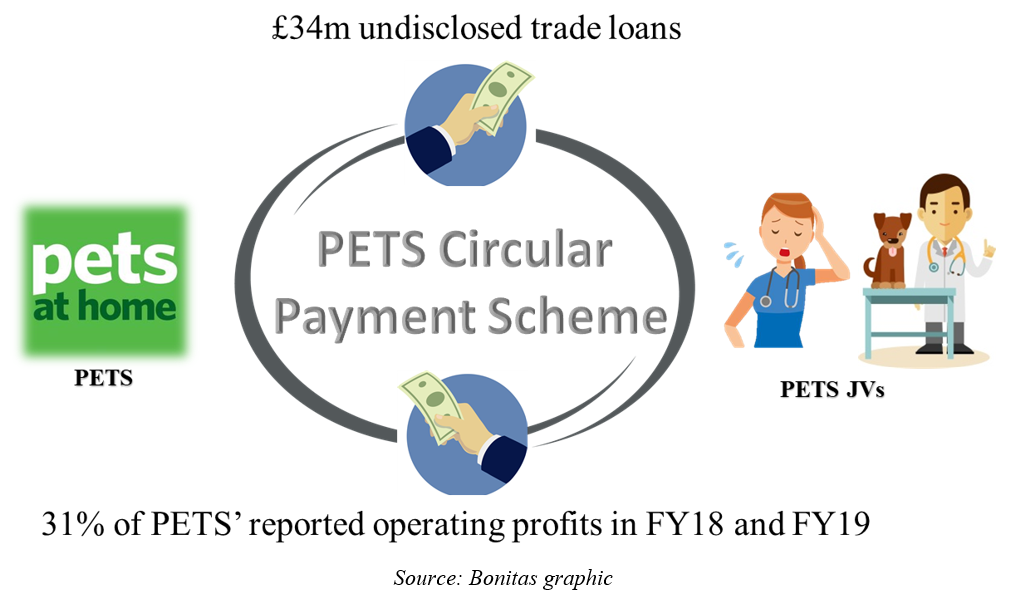
UK Companies House filings revealed that Pets at Home Group Plc (LSE: PETS) (“PETS”) lied about GBP 34 million of undisclosed trading loans hidden from its balance sheet used to support circular payments from PETS Vet Group Joint Ventures (“PETS JVs”) which we believe artificially inflated PETS reported profits.

Including undisclosed trading balances, PETS’ actual funding, trading and operating (“FTO”) loan balances owed by PETS JVs were GBP 74 million and GBP 64 million as of FYE’18 and FYE’19, 87% and 51% greater than what PETS reported in its FY’19 Annual Report. Without these loans, PETS JVs would not have been able to pay PETS service fees and rents.

The circular payment scheme had a significant impact on PETS’ purported profitability. PETS recognized 50%+ operating margins on PETS JV service fees versus 8% for its retail segment. While accounting for only 6% of PETS revenues, PETS JV service fees accounted for 31% of PETS’ operating profits.

We reviewed over 1,800 annual reports for 432 individual PETS JVs between FY’15 and FY’19 available for free online via UK Companies House filings.  Most PETS JVs were loss-making and drowning in liabilities.  In FY’18, while PETS generated GBP 27 million operating profits from PETS JV service fees, PETS JVs generated aggregate losses of GBP 14 million. PETS JVs revealed aggregate liabilities of GBP 170 million as of FYE’19.

Recently PETS actively restructured some PETS JVs via step-up acquisitions and in each instance PETS assumed all PETS JV liabilities. PETS’ restructuring efforts have already cost GBP 40+ million in write-offs and expenses from 55 PETS JV step-up acquisitions as of FYE’19.  As PETS JVs sink deeper into debt, we anticipate that PETS will be forced to bail out and write off additional PETS JVs.

Below are additional highlights from our review of operating PETS JV annual reports:

  • 253 (61%) generated aggregate losses of GBP 27 million in FY’18.
  • 108 (26%) had adminstrative expenses that exceeded revenues in FY’18.
  • 283 (69%) were balance sheet insolvent with aggregate net liabilities of GBP 100 million as of FYE’19.
  • 60 (15%) had net liabilities that exceeded GBP 500,000 as of FYE’19 (not including 19 additional PETS JVs that were bought back and written off by PETS in FY’19).

PETS charged PETS JVs service fees and rents only afforded with concurrent financial support.  If PETS cannot continue to provide such a significant level of financial support to PETS JVs, the scheme collapses.

Source: Bonitas graphic

PETS’ FYE’19 balance sheet held GBP 395 million goodwill largely attributable to the future cash flow generating ability of PETS JVs and reported a contingent liability of GBP 11 million, only 17% of what PETS JVs owed third party banks.

To us, the evidence is clear that PETS lied to investors about the level of financial support given to PETS JVs which artificially inflated PETS’ reported profitability and understated its liabilities.  We believe a restatement of PETS’ financial performance would include adjustments to goodwill, increased recognized exposure to PETS JV bank debt and further write-offs of direct loans to PETS JVs.

As investors consider PETS’ hidden liabilities, its low earnings quality from circular payments and inflated carrying balances for certain assets, we think PETS’ stock price could break previous lows with a downside of 75%+.

JinkoSolar (NYSE: JKS)

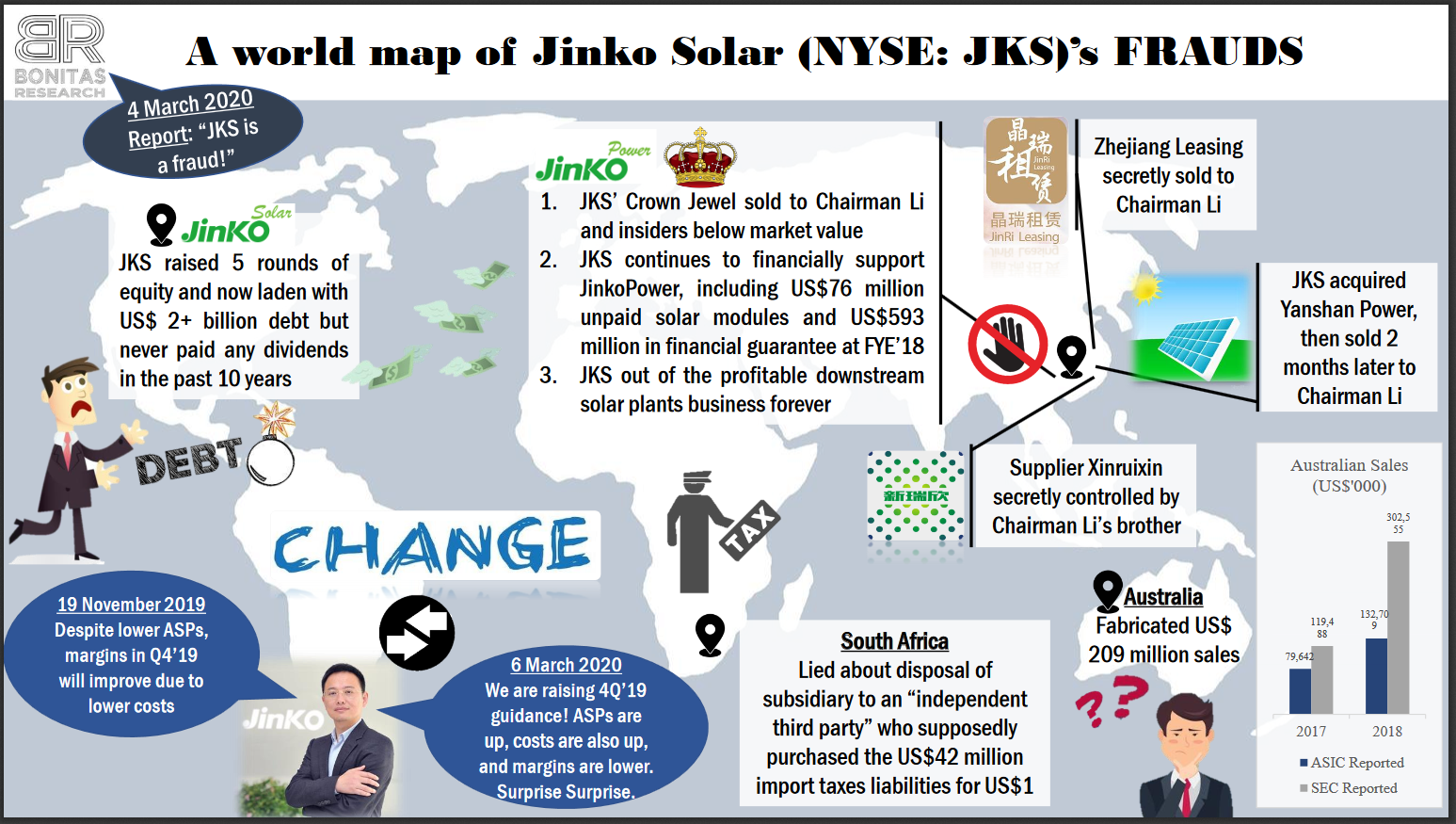
We believe that JinkoSolar Holding Co., Ltd. (NYSE: JKS) (“JinkoSolar” “JKS” or the “Company”) exists for the sole purpose of developing PRC assets with JKS’ cash that were disposed to Chairman Li at a significant discount to market. An older vintage of US-listed Chinese fraud, JKS was fattened up with 5 separate equity issuances and US$ 2+ billion in net debt only to be stripped of value by insiders. This is why JKS, despite its purported profitability, had failed to generate free cash flow or pay shareholders cash dividends.

Evidence shows that Chairman Li privatized JKS’ most valuable assets for himself, leaving JKS shareholders saddled with debts and construction cost liabilities. In 2011, JKS established Jinko Power Technology Co., Ltd. (“JinkoPower”) as a vehicle to construct solar farm power plants that sold electricity to the Chinese State Grid at up to a 33% net income margin, much more profitable than JKS’ 1% net income margin manufacturing solar modules.

In October 2016, JinkoPower was sold to Chairman Li at a US$ 455 million valuation (RMB 3.2 billion). ONE MONTH AFTER Chairman Li purchased JinkoPower at a US$ 455 million valuation from JKS, JinkoPower received an independent appraisal valuation of US$ 720 million accompanied by a PRC insider equity raise at a US$ 788 million valuation. To us, the evidence is clear that Chairman Li acquired JinkoPower at a 40+% discount to market value.

Using US$ 650+ million of JKS’ financial support, Chairman Li grew JinkoPower in 3 years as a private company to seek a US$ 3.6 billion IPO valuation (RMB 25 billion) in 2020, a valuation 692% higher than what Chairman Li paid JKS for JinkoPower!

In addition, Chinese filings reveal Chairman Li’s brother and JKS co-counder Li Xianhua secretly benefitted from controlling a signficant supplier within JKS’ supply chain, a PV glass supplier called Xinruixin, which once again resulted in value meant for shareholders ultimately making its way to Chairman Li and his brother.

Evidence showed that JKS fabricated its 2017 and 2018 financial statements by including US$ 209 million of fake sales to Australia and by omitting US$ 42 million in customs duties that JKS remains liable for in South Africa.

We are short JKS because we think its equity is ultimately worthless.

Everquote (Nasdaq: EVER)

Everquote Inc. (NASDAQ: EVER) (“Everquote” or the “Company”) generates revenue primarily from the sale of online auto insurance quote requests to large insurance providers such as Progressive, Geico, eSurance, Nationwide, Allstate, etc. Calls with Everquote management and two former Everquote employees confirmed language from Everquote’s filings that web traffic to www.everquote.com remained the dominant source of Everquote’s quote requests which continue to be its largest driver of revenue and profitability. On its 3Q’19 earning call, Everquote CFO John Wagner attributed Everquote’s 2019 revenue growth to an increase in website traffic volume to www.everquote.com: “For the balance of 2019, it’s been driven by the progress we’ve made in the execution within our traffic teams in terms of driving more consumers to the website.”

In its 2019 10-Q’s Everquote disclosed that it had over 11+ million average monthly consumer visits to its website www.everquote.com. However, independent data from leading online analytics provider www.similarweb.com (“SimilarWeb”) showed that www.everquote.com only had 4 million visits in September 2019, ~64% less than the reported 11+ million monthly consumer visits Everquote told investors in its 3Q’19 10-Q! SimilarWeb showed website traffic to www.everquote.com was down 71% from January to September 2019 and was down 37% yr/yr in 3Q’19, its lowest web traffic levels since November 2016.

SimilarWeb website analytics data for the past 6 months suggests that the average consumer stayed on www.everquote.com for less than 90 seconds and did not visit 50% of the pages necessary to complete a 40+ field full-form quote request, casting further doubt on the credibility of Everquote’s reported quote request growth in 2019.

We believe SimilarWeb’s website traffic metric data is credible. Everquote’s own filings cited SimilarWeb as a credible source to support its claim as the “largest online marketplace for insurance shopping in the US”. SimilarWeb’s data was corroborated by two additional independent leading analytics providers (Alexa, the website analysis platform provided by Amazon, and Sitechecker) which also showed that Everquote generated significantly less web traffic and experienced weaker user analytics than suggested to investors in its promotional material and SEC filings.

We ask, how did Everquote’s reported 3Q’19 quote requests grow 81% yr/yr and 22% qtr/qtr if web traffic to www.everquote.com declined 71% from January to September 2019 and was down 37% yr/yr in 3Q’19?!?

We attempted a comprehensive review of possibilities how Everquote might have grown quote requests with web traffic to www.everquote.com in decline. These alternatives include an increased number of times a quote request was sold, increased web traffic conversion rate to completed full-form quote requests on www.everquote.com, increased purchase and resale activity of third party quote request leads, increased offline quote requests (calls, TV, radio), or that we failed to account for web traffic to Everquote’s other associated websites. Comments from Everquote management and data analytics from SimilarWeb suggest that Everquote’s reported 2019 revenue and quote request growth were not driven by any one of these alternatives and that web traffic to www.everquote.com remained the dominant driver of quote requests in 2019.

Insiders capitalized on Everquote’s increased stock price. Since July 2019, Everquote insiders cashed in and sold US$ 39 million worth of Everquote stock. In addition to salaries and stock bonuses, Everquote paid US$ 10+ million in the last 18 months to Everquote insider’s privately-held companies for “providing website traffic referrals.” Oddly, most of these privately-held insider marketing company websites displayed negligible website traffic which begs the question of whether the US$ 10+ million was a fair price for related party rendered services or whether the US$ 10+ million was just another way for insiders to benefit at the expense of Everquote’s minority shareholders.

To us, the substantially lower actual web traffic to www.everquote.com suggests Everquote inflated its 2019 reported quote request growth to investors. We would not be surprised if time reveals that Everquote either (a) used a lower profit margin type of revenue and purchased more third party quote request from its verified partner network than claimed, (b) resold each quote request more times than claimed, (c) overstated web traffic and quote requests which suggests overstated unaudited revenues and profits, or (d) other unknowns.

Without further information in the public domain, it is unclear to us where the truth ends and where the lies start from Everquote management about how it was able to achieve such incredible growth in quote requests and revenues in 2019 while web traffic declined significantly to its dominant revenue driver, www.everquote.com.

We are short Everquote and expect its stock to return to its pre-2019 price levels of ~US$ 5/share, a decline of ~75%+ from current prices.

Rural Funds (ASX: RFF)

Regarding: Rural Funds Management Ltd. V. Bonitas Research LLC

October 1, 2019

Dear Mr. Fraser,

This is to respond to your correspondence of September 9, 2019 on behalf of your client Rural Funds Management Ltd. (“RFF”).

We are not going to spend much time familiarizing you with the laws of the United States as we assume you reviewed those laws before deciding to commence an action in Australia against an entity and person who do not do business there, and never been physically present there. You likely understand that the United States safeguards commercial as well as political speech under the First Amendment of the Constitution. You also are probably familiar with the liberal discovery policies of United States courts. To abrogate and avoid the First Amendment protections we hold, as well as to put up roadblocks toward a full airing of the financial unsoundness of your client through a vibrant discovery process, you have commenced litigation in Australia and invited us to participate. We respectfully decline the invitation. Australian courts have no jurisdiction over us, and we will contest the enforcement of any orders or judgments you obtain that certainly will be contrary to the discoverable facts, as well as United States and Texas law and policy.

However, United States Courts do have jurisdiction over RFF as a large percentage of its publicly traded shares were historically held by United States investors. In fact, prior to our initial report on August 6, 2019, United States investors had significant ownership of RFF shares and occasionally held more RFF shares than any other country worldwide, including Australia.

In light of the recent affirmation of our opinions regarding RFF’s financial precariousness by a reputable and totally independent research firm, Bucephalus Research, we are considering a defamation action in the United States against your client. We appreciate we will have to meet a malice standard, but we are more confident than ever that we can do so. Please confirm that you or your client’s Texas counsel will voluntarily accept service of a complaint which, unlike yours, clearly would have no jurisdictional infirmities.

By this letter we are not intending to participate in any way in litigation in Australia.

Very truly yours,

Matthew Wiechert, Bonitas Research LLC

Executive Summary of Comments to Rural Funds (ASX: RFF) September 6, 2019

On August 6, 2019 we published our initial opinion (“Report”) on Rural Funds Group (ASX: RFF) (“RFF”, the “Company”). RFF categorically denied our allegations and adopted a strategy of non-disclosure. In an attempt to credibly rebut our allegations, RFF engaged Ernst & Young to produce a limited scope of work review (“E&Y Report”) which, in our opinion, failed to “address the whole saga”.

The E&Y Report is not an audit, not a clean bill of health, and did not refute our Report’s allegations. While RFF shouts victory, we think the E&Y Report backfired on RFF by highlighting that RFF Management’s fair value calculations included an “incorrect application of AASB 116” specific to RFF’s bearer plants and “identified inconsistencies” specific to RFF’s water entitlement assets.

In RFF Management’s hasty approach to convince the market that our allegations were untrue, RFF made a mistake and revealed how RFF eluded PwC’s audit oversight to include fabricated profits and net asset values in its reported Financial Statements.

RFF’s application of accounting standards led to two restatements in two years, FY’16 and most recently FY’18, both specific to RFF’s application of AASB 116 towards bearer plant valuations. New disclosure revealed that RFF Management took its independent external appraisal valuation for an entire property and, at their sole discretion, decide the fair value allocations into specific accounting classifications of investment property, bearer plants and water entitlements.

This accounting mechanism allowed RFF Management to allocate whatever portion of fair value it wanted within each of its three asset types. The impact of these changes and new disclosures is significant in that it allowed RFF to artificially inflate the value of its assets while concealing its actions from PwC and the investment community.

RFF failed to explain how in the last 8 years its mature almond trees increased in value from A$ 17.9 million to A$ 82 million!

RFF failed to explain how in the last 5 years its Vineyards increased in value from A$ 12.9 million to A$ 37.7 million with only A$ 152,000 of additional investment!

In our experience, subtle and nuanced applications of accounting policy changes are used to facilitate “accounting gimmickry” or “financial shenanigans” and conceal from auditors fake transactions and fabricated inputs for assumptions and judgements determined solely by RFF Management.

We received a document preservation request from a Texas law firm on behalf of RFF which suggests RFF started the process for a potential defamation lawsuit in Texas. Others have attempted to sue us before. To be clear, we have never retracted an opinion. We have never removed or modified a report published on our website. We stand by or work and are prepared to defend ourselves legally if necessary.

We are aware that the next step in this process is document discovery, which would legally force RFF to reveal key internal documents which we believe contains evidence that RFF artificially inflated its reported profits and net asset values. We encourage additional disclosure from RFF so that investors know the truth and RFF Management can no longer take advantage of unsuspecting minority shareholders.

Beware to those that invest in the public markets. There are plenty of criminals that raise money from unsuspecting investors with stamps of approval from Big 4 auditors. RFF Management has proven their interest in burying our allegations in the past, playing a game with market participants of deflection and deception instead of transparency and disclosure.

The TRUTH will prevail. Because of this, we remain short RFF and believe RFF’s equity is ultimately worthless.

Best World (BB:BEST __ SGX:CGN)

We believe that Best World is a fraud and that its Chinese sales are a fraction of what was reported to shareholders.

On March 19, 2019, Best World International Ltd. (BB: BEST __ SGX: CGN) (“Best World” or the “Company”) disclosed to its shareholders that it hired PricewaterhouseCoopers (“PwC”) to conduct a limited, one-year independent review of its 2018 China operations. We think Best World management purposely focused PwC’s investigation solely on 2018 in an attempt to both divert attention from, and ultimately further conceal, previously reported fake sales and profits from its China operations.

PRC Filings suggest that Best World fabricated at least S$ 31 million of its reported 2017 sales to its “one major customer” (“Changsha Best”), an entity Best World management secretly controlled and exclusively created to be Best World’s off-books China counterparty. Excluding fabricated sales to Changsha Best, we calculate that Best World overstated its 2017 net profits by at least 130%.

Since January 2019 we have communicated with 24 separate Best World China member representatives (“Member Rep(s)”) and have conducted field visits to 12 BWL Lifestyle Centers (~36% of Best World’s listed franchisee locations) to better understand Best World’s sales model.

Our findings suggest there exists very little end user consumer demand for DR’s Secret skin care products in China. In addition, evidence suggests that since the February 18, 2019 Singapore Business Times article (the “BT Article”), online vendors on both JD.com and Taobao.com appear to have artificially inflated their online review counts and transaction history to give a false appearance of online sales activity.

We found that 8 of the 12 BWL Lifestyle Centers we visited did not sell individual products to non-members. Our investigators commented that employees at BWL Lifestyle Centers disclosed and acted as though they were not accustomed to interacting with walk-in customers. We laugh at this, but we were told by on-site employees at one BWL Lifestyle Center that we were their very first walk-in customer despite their lifestyle center being open since October 2017!

As reward for their fraudulent scheme, Best World’s founders (the “Dora’s”) exponentially accelerated their combined annual take home pay by 20x in five years, earning less than S$ 2 million in 2013 to receiving S$ 40+ million in cash in 2018! In the three years since implementing the scheme, the Dora’s collectively took home S$ 85 million in cash, while Best World exited 2018 with its trade and payables balance at an all-time high of S$ 95 million and its receivables touching all-time lows at S$ 5.2 million.

We are short Best World stock and believe its stock price will go lower.